 easywall
GitHub ↗
easywall
GitHub ↗
Environment Variables
Every variable easywall reads, the TOML key it names, and whether the interface has a control for the same value. What each key configures, and the file it lives in, is on the Configuration page.
Which value wins
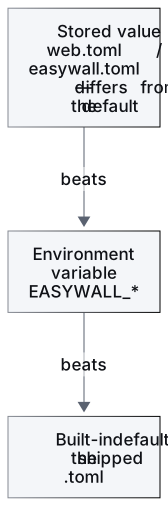
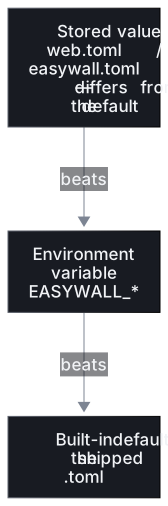
| Environment | Stored | In effect |
|---|---|---|
| — | — | the built-in default |
| set | — | the environment |
| set | differs | the stored value |
| set | differs, but equals the environment | the stored value — which is the same thing |
| removed | differs | the stored value |
Stored means the file’s value differs from the built-in default — not that
the key is present in the file. easywall-core -write-config and
easywall-web -write-config emit every default, and that is exactly the file the
container image ships. If presence counted, every variable in this page would be
dead on every containerised installation.
A boolean is compared after parsing, not as text, so a stored true and an
environment of 1 are the same value. That’s the fourth row above, not a
conflict for the interface to draw.
A control that names a key you have also set through the environment says so on the page. It offers Reset to the environment value when your stored value is the one in effect.
easywall-core
| Variable | easywall.toml key |
Type | Control | Purpose |
|---|---|---|---|---|
EASYWALL_CORE_SOCKET_PATH |
socket_path |
string | — | Unix socket path — must be accessible to the easywall group |
EASYWALL_CORE_DATA_DIR |
data_dir |
string | — | Directory for rules.json, the last-apply state and the panic marker |
EASYWALL_CORE_LOG_DIR |
log_dir |
string | — | Directory for the audit log and rule snapshots |
easywall-web
| Variable | web.toml key |
Type | Control | Purpose |
|---|---|---|---|---|
EASYWALL_WEB_BIND_ADDR |
bind_addr |
string | — | Listen address and port — e.g. 0.0.0.0:12227 |
EASYWALL_WEB_SOCKET_PATH |
socket_path |
string | — | Path to the core Unix socket — must match easywall.toml |
EASYWALL_WEB_SSL_DIR |
ssl_dir |
string | — | Directory where the auto-generated TLS cert/key are stored |
EASYWALL_WEB_DATA_DIR |
data_dir |
string | — | The data directory; the web process keeps its state in web/ inside it |
EASYWALL_WEB_TLS_CERT |
tls.cert |
string | — | Path to a custom TLS certificate PEM file |
EASYWALL_WEB_TLS_KEY |
tls.key |
string | — | Path to the matching private key PEM file |
EASYWALL_WEB_LANGUAGE |
language |
string | sidebar switch, per browser | Fallback UI locale — en or de |
EASYWALL_WEB_UPDATE_CHECK |
update_check |
bool | — | Ask github.com once a day whether a newer release exists |
EASYWALL_WEB_DEMO_MODE |
demo_mode |
bool | — | Run against an in-memory mock instead of the core — the public demo only |
EASYWALL_WEB_TELEMETRY |
telemetry |
bool | System | Report this installation once a day — off unless set |
EASYWALL_WEB_TRUSTED_PROXIES |
trusted_proxies |
list | — | Comma-separated addresses and networks whose X-Forwarded-For header is believed |
EASYWALL_WEB_HEALTH_ALLOW |
health_allow |
list | — | Comma-separated addresses and networks that may read /healthz. Loopback unless you widen it — and a non-loopback bind_addr must be added here, or the container’s own HEALTHCHECK is refused |
A list variable is comma-separated: EASYWALL_WEB_TRUSTED_PROXIES=127.0.0.1,10.1.0.0/24.
Whitespace around an entry is ignored and an empty field is dropped, so a
trailing comma is not an entry. An entry that is neither an address nor a
CIDR network stops startup and names itself.
Setting up the proxy itself is Behind a reverse proxy.
The language switch in the sidebar sets a cookie for the browser you are reading
in. It does not write web.toml, so it neither overrides EASYWALL_WEB_LANGUAGE
nor is overridden by it: the variable decides the language a browser with no
cookie sees.
TZ
Not in either table above because it is not read by easywall at all — the Go
runtime reads it through tzdata, the same as any other Go binary. It sets the
zone the interface renders timestamps in: the audit log, Applied and
Confirmed times, everything with a clock on it. Without it a container runs
UTC, and an operator in another zone reads every entry offset by their own.
What you cannot set here, and why
The rule in one sentence: the environment configures where easywall runs; the interface configures what the firewall does.
- Rule settings and the acceptance window — every
[firewall]switch and limit,[ipv6],[docker],[routing],acceptance.duration— are written by the interface. A variable overriding one of these would be undone the next time the container restarts and rereadseasywall.toml, silently, with the interface having reported the change as saved.docker.published_portsis the one key the interface does not write either, for the reason Docker Coexistence gives. It is still not a variable: a container that came up with it set would close every published port before anyone could look. - Credentials, the session key, the TOTP secret, the recovery codes —
username,password,session_key,totp_secret,recovery_codes— are secrets, and an environment variable is not one. It is visible todocker inspect, to anything that reads/proc/<pid>/environ, and to whatever log somebody pastes into an issue.web.tomlis0600; the environment of a running container is not. - Being counted —
telemetry— is settable here, and it is the one key the interface also writes. The public demo is configured entirely from its environment and reports like any other installation. An answer given in the interface is a stored value and beats the variable; Reset to the environment value on the System page is the way back.
Behaviour
An empty variable counts as unset — -e EASYWALL_WEB_LANGUAGE= leaves the
file’s value alone rather than blanking it. A boolean variable is read with
strconv.ParseBool, so 1, t, T, true, TRUE and True all mean true
and 0, f, F, false, FALSE and False all mean false. Anything else
stops the process at startup, with the variable named in the error. Prefer
true and false — the rest are accepted, not recommended.
Compose example
Based on the repository’s own docker-compose.yml, with a handful of the
variables above added:
services:
  easywall:
    image: ghcr.io/jp1337/easywall:latest
    container_name: easywall
    restart: unless-stopped

    environment:
      - TZ=${TZ:-UTC}
      - EASYWALL_CORE_DATA_DIR=/var/lib/easywall
      - EASYWALL_WEB_BIND_ADDR=0.0.0.0:12227
      - EASYWALL_WEB_LANGUAGE=de
      - EASYWALL_WEB_UPDATE_CHECK=false

    network_mode: host
    cap_add:
      - NET_ADMIN
    security_opt:
      - no-new-privileges:true

    volumes:
      - ./easywall-config:/etc/easywall
      - easywall_data:/var/lib/easywall
      - easywall_logs:/var/log/easywall

volumes:
  easywall_data:
  easywall_logs: