 easywall
GitHub ↗
easywall
GitHub ↗
Health Check
Everything easywall reported before 2.17 was a claim about intent: a table exists, a daemon is up, a rule set was applied. For five releases the stateful half of the input chain matched no packet while every one of those said the firewall was active.
The health check reports effect. This page is how you wire it up.
The three surfaces
| Answers with | Reach for it | |
|---|---|---|
easywall-core health |
three lines and an exit code | a cron or Nagios-style check on the host |
GET /healthz |
JSON on the web port | a monitoring system over the network |
| Docker and systemd | nothing to configure | container restarts and unit ordering |
easywall-core health
$ easywall-core health
health:     ok
reason:     healthy
selftest:   unprovable for 2.17.0 on 6.12.48-1-lts at 2026-09-09T07:41:02Z
| Exit code | State |
|---|---|
0 |
ok |
1 |
degraded, or a reply this binary cannot read |
2 |
fail, including a daemon that is not running |
2 covers no daemon on purpose. Being unable to confirm that a firewall is up
is not the same as it being up.
It disagrees with easywall-core status under panic mode, deliberately.
status exits 0 — somebody chose to unfilter this machine, and a console
asking after intent is right to be quiet. health exits 2, because a
monitoring system is asking a different question.
GET /healthz
The one route on the web process that answers without a session, because an orchestrator holds none.
/healthz reads the kernel, so it waits for an apply that is in progress. A
custom-rules apply can hold that for up to 30 seconds. The endpoint answers
503 during it, and the container’s health check reaches its third failure
inside that window. Nothing restarts: an unhealthy container is a label, not
an action.
curl -sk https://127.0.0.1:12227/healthz
{
  "state": "ok",
  "reason": "healthy",
  "selftest": {
    "version": "2.17.0",
    "result": "unprovable",
    "at": "2026-09-09T07:41:02Z"
  }
}
The body is deliberately thin. No rule detail, no counters, and no kernel
release — this route is unauthenticated, so it says the least that a monitoring
system can act on. The dashboard names the kernel; /healthz never does.
A stamp nothing has recorded — a container, where the proof does not run —
renders "selftest": {} rather than empty strings. Absence is the answer;
result is only ever one of passed, failed or unprovable.
| Code | When |
|---|---|
200 |
ok and degraded |
503 |
fail, and a core that does not answer |
404 |
the caller is not on health_allow |
degraded answers 200 on purpose. A degraded firewall is still filtering, and
every cause of it survives a restart unchanged. Marking a container unhealthy
for one would restart a working firewall and drop every connection through it.
Alert on the state field instead.
404 rather than 403: not confirming that the endpoint exists costs nothing,
since whoever is allowed gets the real answer anyway.
Docker and systemd, without configuration
| The image | HEALTHCHECK runs easywall-web -healthcheck every 10s, 15s start period, 3 retries — /healthz at the address bind_addr names |
docker-compose.yml |
carries the same check under healthcheck:, because podman’s default image format has nowhere to keep the image’s; a test keeps the two identical |
easywall-core.service |
Type=notify — active (running) means the socket exists |
WatchdogSec=60, so a wedged daemon is restarted rather than left listening |
A fresh container reads unhealthy until you apply rules for the first time,
because it genuinely is not filtering yet. That is honest rather than broken, and
it has one consequence: a depends_on: condition: service_healthy on easywall
will wait for ever until the first apply. The old check could not see this — it
looked at the core’s socket.
Letting a monitoring host in
/healthz starts closed to everything but loopback. It publishes the firewall’s
state to whoever can read it. The gate reads the TCP peer, never a forwarding
header, so nothing behind a proxy can claim to be loopback.
Moving
bind_addrneeds nothing here. The container’s check asks/healthzat the bound address and from it, and the endpoint admits a peer that is its own local address. Widen the list for a monitoring host, not for the check.health_allow = []still closes the endpoint to everyone, the container’s check included.This is not a loopback exception. Any process on this host that connects to the bound address is admitted the same way, a same-host reverse proxy relaying remote traffic included. Unless the list is
[], it is not the complete set of admitted peers.
# /etc/easywall/web.toml
health_allow = ["127.0.0.1/8", "::1/128", "10.20.0.0/24"]
EASYWALL_WEB_HEALTH_ALLOW sets the same list, comma-separated.
| You write | You get |
|---|---|
| the key, with entries | those addresses and networks, and nothing else |
| the key, empty list | the endpoint off entirely |
| no key at all | the loopback default above |
The list is matched against the TCP peer and never against X-Forwarded-For.
A proxy in front of easywall cannot pass a monitoring host through it — list the
proxy’s own address. See Security.
The three states, and the reason each carries
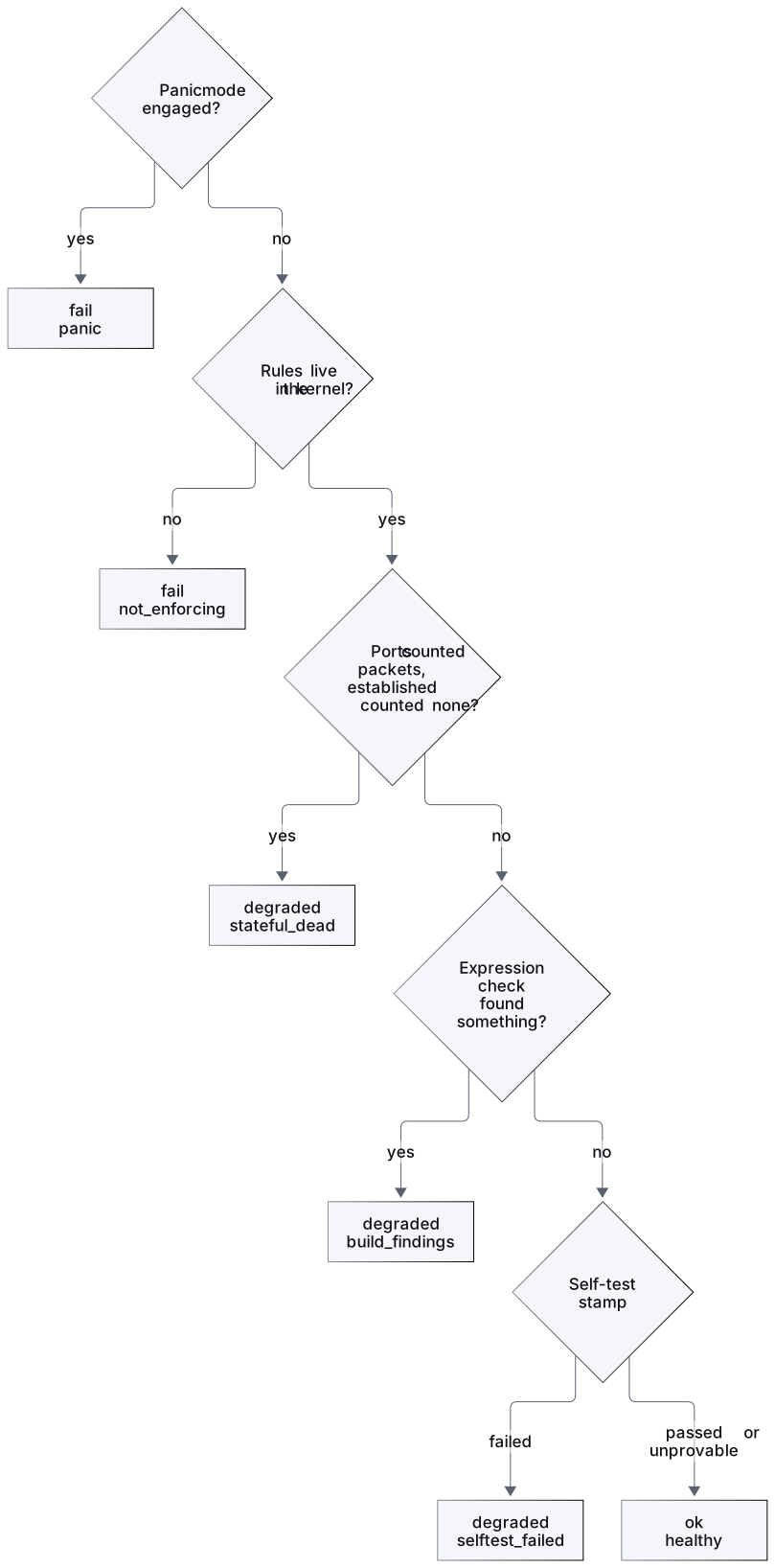
| State | Reason | What it means |
|---|---|---|
ok |
healthy |
rules are live and the stateful half is matching packets |
degraded |
stateful_dead |
ports counted packets, the established rule counted none |
degraded |
build_findings |
a rule reached the kernel that the expression check could not believe |
degraded |
selftest_failed |
the self-test disproved a claim about the rule builder |
fail |
not_enforcing |
the kernel is not carrying easywall’s rules |
fail |
panic |
somebody ran easywall-core panic, and it survives a reboot |
fail |
core_unreachable |
the web process asked and got no answer |
stateful_dead is the defect this release exists to catch. It needs both halves:
established == 0 on a host with no traffic is honest, so the alarm also wants
the port counters to have moved.
core_unreachable comes from the web process and never from the core. A crashed
core says nothing about the kernel, which may still be filtering perfectly.
unprovable is normal, and is not a fault
The self-test reports unprovable on most installations, and the health state
stays ok.
Proving anything needs a network namespace of easywall’s own, which needs
CAP_SYS_ADMIN. The daemon holds CAP_NET_ADMIN and nothing else, so it cannot
build one — and neither can an ordinary container. Being unable to prove
something is not the same as it being broken.
Where you will meet it: running easywall-core selftest by hand on a live
host. Expected — one claim needs an inbound connection accepted host-side as
its control, and the table already in place refuses it. That is why the shipped
proof runs from a oneshot unit ordered before the daemon.
In a container you meet something else. The image asks for CAP_NET_ADMIN and
nothing else, so the proof cannot run there and never will. The selftest line
reads unavailable here rather than never recorded — the first names a
capability, the second names a chore somebody ought to clear. /healthz renders
"selftest": {}, the dashboard omits the fact, and the state stays ok.
Never recorded still appears where it is true: a host that could run the
proof and has not. There, easywall-core selftest clears it.
Proving a port that answers nothing
If the question is only has this rule ever matched, the ports page’s
Last used column already answers it from these same counters. What follows
is for the question it cannot: the forward chain’s drop is not a rule of
yours and has no row there.
unprovable is easywall declining to measure its own claim. The same problem
arrives from the other side. A UDP service that never replies looks the same
whether the firewall dropped the packet or the service ignored it. No probe that
waits for an answer can separate the two.
The rules count packets. Ask them instead of asking the service.
sudo nft list table inet easywall > /tmp/before
#   from the outside host, send what needs no reply
#   dig @198.51.100.7 example.com   ·   nc -u host 514   ·   nmap -sU -p 53 host
sudo nft list table inet easywall > /tmp/after
diff /tmp/before /tmp/after
Do not apply rules in between. An apply rewrites the table, and that zeroes every counter in it.
| The counter that moved | Reading |
|---|---|
an accept on that port |
the packet arrived and easywall let it through — what the service did with it is not easywall’s business |
the forward chain’s drop |
it arrived and easywall dropped it. A published container port with no forwarded rule is the usual cause |
| nothing moved | nothing arrived. Read the path in front of easywall — a provider firewall, a NAT, the wrong address |
This is how the port published on a bridge gateway in Docker coexistence was found: every container’s DNS was gone while fifteen external probes stayed green.
The self-test
Four claims, each measured with a real packet over a veth pair rather than read off the rules.
What it creates on your host, at every boot after an upgrade. A veth pair
named ewst-r and ewst-p, addressed 10.77.9.1 and 10.77.9.2 in
10.77.9.0/24, with ewst-p moved into a throwaway network namespace. The
pair is removed when the proof finishes. Two things worth knowing before it
runs:
- The range is fixed. If your own LAN is
10.77.9.0/24, the proof adds a route that collides with it for the seconds it runs. - The names are fixed, and setup clears them by name. Any host interface
literally called
ewst-ris deleted before the pair is built — whoever made it — and deleting one end of a veth takes its peer with it.
The claims:
- a reply on an established connection passes
- an open port accepts a connection
- a closed port does not
- a blocklisted address does not reach an open port
A disproved claim records failed, which reads degraded — never a refusal to
filter. No layer of this ever declines to put the rules in the kernel.
It runs once per version and kernel. easywall-selftest.service runs
selftest --if-stale before the daemon starts, and a stamp that already matches
both is not re-proven. The defect class it catches is a build defect: identical
on every start of the same binary, so proving it once is enough.
systemctl start easywall-selftest    # honour the stamp
easywall-core selftest               # force it, and rewrite the stamp
The bare subcommand always runs. Reach for it after changing a rule builder —
the reason to run it by hand is to distrust what is recorded. It prints a
detail line naming the claim that failed, which /healthz deliberately never
carries.
unprovable exits 0 and a disproved claim exits 1. The unit lists
SuccessExitStatus=0 1 2, so neither can fail a boot.
Both outcomes reach
the audit log as
selftest_passed or selftest_failed, and the
dashboard carries the state
with its reason in words.
Next: Recovery & Panic Mode · Dashboard · Configuration